


Early Intervention Program
What Is an Early Intervention Program?
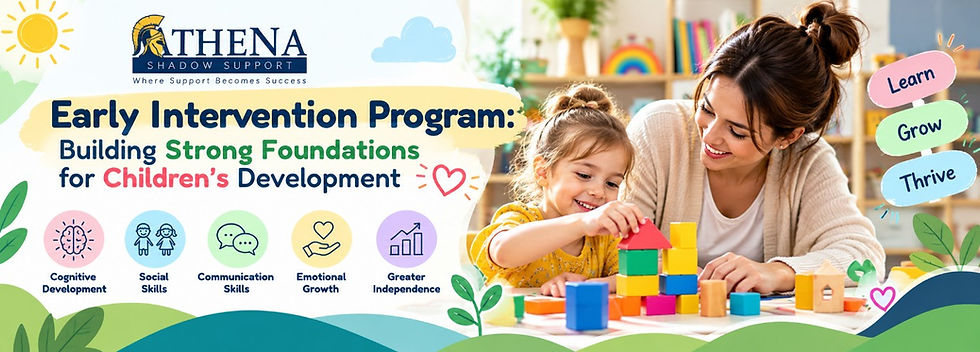
An Early Intervention Program is personalised support for young children who may need additional help with developmental, learning, communication, behavioural, social or motor skills.
Instead of using the same approach for every child, early intervention can be adapted according to a child's current abilities, strengths and developmental goals.
Depending on individual needs, an early intervention program may focus on:
Speech and language development
Communication and listening skills
Social interaction
Emotional development
Attention and learning
Cognitive skills
Fine motor development
Gross motor development
Positive behaviour
Sensory processing
School readiness
Daily living and independence skills
Athena's home-based programme specifically identifies speech and language delays, autism spectrum disorder, developmental delays, social communication challenges, attention and behavioural difficulties, sensory processing challenges, motor-skill delays and school-readiness concerns among areas where children may benefit from support.
Why Is Early Intervention Important?
The early childhood years provide many opportunities for learning through play, communication and everyday experiences. When a child experiences difficulty in one or more developmental areas, personalised support can provide additional opportunities to practise emerging skills.
Early intervention does not mean that parents should compare their child with other children or expect every milestone to happen at exactly the same age. Developmental milestones are guidelines, and children can progress at different rates. Athena also emphasises that every child develops at their own pace.
The purpose of early intervention is to understand the child's individual needs and provide appropriate opportunities for development.
Who Can Benefit From Early Intervention?
An early intervention program may be appropriate for children who experience challenges in one or several developmental areas.
Parents may consider seeking professional guidance when they notice concerns involving:
Limited communication or delayed speech
Difficulty understanding or following instructions
Limited social interaction
Challenges with emotional regulation
Delayed fine or gross motor skills
Difficulty concentrating or participating in activities
Sensory processing concerns
Developmental delays
Behavioural difficulties
Challenges with early learning or school readiness
A single missed milestone does not necessarily indicate a developmental problem. However, if parents have ongoing concerns or notice a loss of skills that a child previously developed, discussing those concerns with an appropriate paediatrician or child-development professional can be helpful.
What Skills Does Early Intervention Develop?
1. Communication and Language
Communication is one of the most important foundations for learning and social interaction.
Early intervention can create opportunities for children to practise:
Expressing wants and needs
Understanding language
Listening
Responding to questions
Using words or other communication methods
Participating in conversations
Communicating with family members and peers
Athena's home-based programme includes communication and language development activities designed around the child's individual needs.
2. Social and Emotional Development
Children gradually learn how to interact with others, take turns, share, express emotions and participate in social situations.
Early intervention can support skills such as:
Turn-taking
Social engagement
Relationship building
Recognising emotions
Emotional regulation
Participating in shared activities
These skills can help children become more comfortable participating at home, in preschool and in community environments.
3. Cognitive and Learning Skills
Young children learn through exploration, play and interaction. Early intervention can incorporate activities that encourage attention, memory, problem-solving and early learning.
Age-appropriate activities may include puzzles, matching games, sorting, storytelling, simple instructions and play-based learning.
Athena identifies attention, problem-solving, memory, early literacy and foundational learning abilities as areas addressed through its home-based intervention approach.
4. Fine and Gross Motor Skills
Motor development affects many everyday activities.
Fine motor activities can help children practise hand and finger coordination, while gross motor activities can support movement, balance and body coordination.
Depending on the child's needs, intervention activities may include:
Drawing
Manipulating objects
Handwriting preparation
Building activities
Ball games
Balance activities
Movement-based play
Athena's programme includes sensory and motor activities and identifies fine and gross motor delays among potential areas of support.
What Is Home-Based Early Intervention?
Home-based early intervention takes place in the child's familiar environment rather than relying only on a centre-based setting.
This approach can make it easier to incorporate learning into everyday activities. A child may practise communication during mealtimes, social interaction during play, motor skills through age-appropriate activities, or independence skills during daily routines.
Athena states that its home-based intervention sessions are conducted in a familiar environment and are designed to make learning practical and connected to the child's everyday experiences.
Why Is Family Involvement Important?
Parents and caregivers play a central role in a child's development because they provide learning opportunities throughout the day.
A successful early intervention program therefore does not have to stop when a session ends. Parents can reinforce appropriate strategies during normal routines.
Athena's approach includes parent coaching and guidance, with caregivers encouraged to create additional learning opportunities through everyday activities.
For example, a parent might practise communication during breakfast, encourage turn-taking during play or help a child follow a simple routine independently.
Consistency can help children practise skills in different situations rather than only during intervention sessions.
What Happens During an Early Intervention Session?
The exact structure of an intervention session depends on the child's needs and goals.
Activities may include:
Play-based learning
Communication exercises
Social interaction activities
Sensory activities
Motor-skill exercises
Behavioural support strategies
Early learning activities
Parent coaching
Progress monitoring
Athena states that sessions are individually planned and adjusted according to a child's progress and changing developmental needs.
Early Intervention and School Readiness
Early intervention can also help prepare children for future educational environments.
School readiness is not simply about knowing letters or numbers. Children also need to develop skills such as:
Listening and following instructions
Communicating needs
Participating in group activities
Managing transitions
Paying attention
Interacting with peers
Following routines
Developing independence
Building these foundational skills can help children approach preschool and school environments with greater familiarity and confidence.
How Do Parents Choose an Early Intervention Program?
Parents considering an early intervention program may want to ask several important questions:
Is the program personalised?
Children have different strengths and developmental needs, so support should reflect the individual child.
Are parents involved?
Look for opportunities to understand and reinforce strategies at home.
How is progress monitored?
Ask how goals are established, reviewed and adjusted.
Is the environment appropriate for the child?
For some children, learning in a familiar home environment may be particularly practical.
Does the program focus on independence?
Support should help children develop usable skills rather than simply provide assistance.
Are qualified professionals involved?
Parents should understand who will provide the service and what experience or training they have.
FAQ About Early Intervention
What is an Early Intervention Program?
An Early Intervention Program provides personalised developmental support for young children who may experience delays or challenges involving communication, learning, social interaction, behaviour or motor development.
When should a child start early intervention?
There is no single age that applies to every child. If parents have concerns about development, they can seek advice from a paediatrician or child-development professional and explore whether additional support is appropriate. Early support does not require parents to wait until a child reaches a particular age.
Can early intervention help children with speech delays?
Early intervention can include communication and language development activities. The specific approach depends on the child's individual needs and should be determined with appropriate professional guidance.
Is home-based early intervention effective?
Home-based intervention allows developmental activities to be incorporated into familiar routines and environments. Athena's programme is designed around this approach and includes family involvement, practical learning opportunities and progress monitoring.
Does early intervention only support children with autism?
No. Early intervention can address a wide range of developmental needs, including communication delays, developmental delays, learning concerns, behavioural difficulties and motor-skill challenges. Athena's programme lists several of these areas.
Building a Stronger Foundation for the Future
An Early Intervention Program can give children additional opportunities to practise important skills during their early developmental years. When support is personalised and connected to everyday life, children can work on communication, social interaction, learning, motor development, behaviour and independence in meaningful ways.
For parents, early intervention is also about understanding their child's unique strengths and finding practical ways to support development at home and in the community.
For families in Singapore looking for personalised support, Athena Shadow Support's Home-Based Early Intervention Programme combines individualised activities, family involvement and learning within familiar daily routines.
If you have concerns about your child's development, consider discussing them with an appropriate healthcare or child-development professional and exploring support options suited to your child's individual needs.
Enquire with Athena Shadow Support: https://www.athenashadowsupport.com/contact-us
Comments