


Shadow Teacher
What Is a Shadow Teacher?
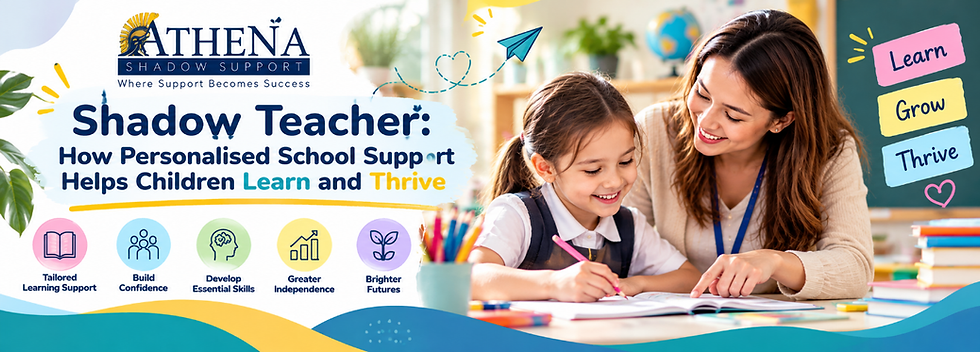
A shadow teacher is a trained professional who provides personalised support to a child within the school environment. Also known as a learning support assistant in some settings, a shadow teacher works alongside the student while coordinating with classroom teachers and adapting to the flow of the school day.
Unlike a traditional private tutor, whose primary responsibility is usually academic instruction, a shadow teacher can support a much broader range of school-related needs.
Depending on the child's individual requirements, support may include:
Understanding classroom instructions
Staying focused during lessons
Completing classroom activities
Developing organisational skills
Managing transitions
Participating in group activities
Developing communication skills
Building positive peer relationships
Supporting emotional and behavioural regulation
Encouraging independent learning
Athena describes its shadow teachers as professionals who provide personalised, in-the-moment assistance while helping children engage meaningfully in everyday school activities.
Why Might a Child Need a Shadow Teacher?
A classroom teacher has to support an entire group of students. Although teachers work hard to accommodate different learning styles, providing continuous individual attention to one child can be difficult.
Some children may require additional assistance because of:
ADHD
Autism spectrum-related support needs
Learning difficulties
Language or communication delays
Behavioural challenges
Social and emotional difficulties
Mild cognitive delays
Difficulties with attention and organisation
This does not mean that a child cannot learn in a mainstream classroom. Instead, additional support can help remove barriers that may otherwise make classroom participation more difficult.
Athena's shadow teacher programme specifically supports children with behavioural challenges, high-functioning autism, moderate language or learning difficulties, mild cognitive delays and ADHD.
What Does a Shadow Teacher Do?
The responsibilities of a shadow teacher depend on the child's needs and the goals established with parents and educators.
1. Provides Individualised Learning Support
Some children understand a lesson but struggle to process instructions or start a task independently.
A shadow teacher can help by breaking larger activities into manageable steps, repeating or simplifying instructions, using appropriate prompts and encouraging the child to attempt tasks themselves.
The objective is not to complete schoolwork for the child. Instead, the support professional helps make learning more accessible while encouraging active participation.
2. Helps Children Stay Focused
Maintaining attention throughout a school day can be challenging for some children.
A shadow teacher can provide discreet reminders, organisational strategies and appropriate encouragement to help the child return to the task.
Over time, the child can learn strategies for managing attention and completing tasks with less direct prompting.
3. Supports Social Interaction
Academic success is only one part of a child's school experience.
Children also need opportunities to communicate, cooperate, share, take turns and develop relationships with classmates. A shadow teacher can encourage appropriate peer interaction and provide guidance when social situations become challenging.
Athena's approach includes helping children develop social confidence and participate more meaningfully in the school community.
4. Supports Classroom Transitions
Moving between lessons, classrooms and activities can be difficult for some children.
A shadow teacher can help a child understand what is happening next, prepare for changes and follow familiar routines. Predictability and consistent support can make transitions easier to manage.
5. Encourages Independence
One of the most important goals of effective shadow teaching is independence.
A shadow teacher should not become a permanent replacement for a child's own skills. Instead, support can be gradually adjusted as the child becomes more confident.
For example, a child who initially needs frequent prompts to organise their school materials may eventually need only one reminder—and later may complete the routine independently.
Athena states that its goal is to empower children rather than simply manage behaviour, with the possibility of reducing support as confidence and skills develop.
Shadow Teacher vs Classroom Teacher
A classroom teacher and a shadow teacher have different but complementary roles.
Classroom Teacher | Shadow Teacher |
Teaches the whole class | Provides individualised support to a specific child |
Delivers the curriculum | Helps the child access and participate in the curriculum |
Manages overall classroom learning | Focuses on the child's individual needs |
Plans lessons and assessments | Provides personalised prompts and strategies |
Supports the wider class | Works closely with the child and relevant educators |
The two roles should work together rather than operate separately. Effective communication between the classroom teacher and shadow teacher can create greater consistency for the child.
How Shadow Teachers Support Inclusive Education
Inclusive education aims to ensure that children with different learning needs can participate meaningfully in educational settings.
However, inclusion is not necessarily about giving every child identical support. Some students may need additional strategies or individual assistance to access the same learning opportunities as their classmates.
A shadow teacher can act as a bridge between the child's individual needs and the classroom environment.
Athena Shadow Support works with both MOE and international schools, including preschools, providing support designed around academic, social, emotional and behavioural needs.
Working With Parents and Schools
Successful shadow support is usually collaborative.
Parents provide important information about the child's personality, strengths, routines and experiences. Teachers understand the curriculum, classroom expectations and school environment. The shadow teacher contributes observations about the child's participation and areas where additional strategies may help.
Athena also offers Individualized Education Plans (IEPs), working with parents and educators to develop personalised goals and strategies for a child's educational journey.
Regular communication can help everyone understand what is working, identify areas that need adjustment and maintain consistency between home and school.
What Makes an Effective Shadow Teacher?
The right shadow teacher needs more than classroom experience. They should be able to understand the child's individual needs and adapt their approach accordingly.
Parents may consider the following when choosing a shadow teacher:
Experience and Training
Ask about experience supporting children with similar learning, communication or behavioural needs.
Communication
The shadow teacher should communicate appropriately with parents and collaborate respectfully with school staff.
Individualised Support
A child's support plan should reflect their strengths, challenges and educational goals.
Patience and Empathy
Children may need time to build trust. A calm and respectful approach can help create a positive learning relationship.
Focus on Independence
Support should encourage children to develop their own skills instead of creating unnecessary dependence.
Athena describes its process as including consultation, assessment, matching a shadow teacher to the child's needs, implementation and ongoing reviews with parents and teachers.
How Long Does a Child Need a Shadow Teacher?
There is no universal answer.
Some children may need support during a particular stage of development, while others may benefit from longer-term assistance. The appropriate duration depends on the child's needs, progress, school environment and individual goals.
It is also important to understand that progress may not happen immediately. Children often need time to become comfortable with a new support professional, understand routines and develop new strategies.
The long-term objective should be meaningful progress—not simply maintaining the same level of adult assistance.
FAQ About Shadow Teachers
What is the main purpose of a shadow teacher?
The main purpose is to provide personalised support that helps a child participate in school academically, socially and emotionally while developing greater independence.
Is a shadow teacher the same as a tutor?
No. A tutor primarily provides academic instruction, while a shadow teacher works within the school environment and may support academic, social, behavioural, communication and organisational needs.
Does every child with autism need a shadow teacher?
No. Support requirements differ between children. Some children may benefit from individual classroom assistance, while others may be able to participate successfully with different forms of support.
Can a shadow teacher help with social skills?
Yes. Depending on the child's goals, a shadow teacher can encourage communication, peer interaction, turn-taking and participation in group activities.
Will a child always need a shadow teacher?
Not necessarily. An independence-focused support plan may involve gradually reducing prompts and assistance as the child's skills and confidence develop. Athena specifically states that some children can reduce support over time.
Where can families find shadow teacher support in Singapore?
Athena Shadow Support provides shadow teacher and related educational support services in Singapore. Families can contact the organisation to discuss their child's individual needs and available options.
Helping Children Move Forward With Confidence
A shadow teacher can provide an important bridge between a child's individual needs and the demands of the school environment. With personalised guidance, collaboration and appropriate strategies, children can receive the assistance they need while continuing to participate alongside their peers.
Most importantly, good shadow support should look beyond the immediate challenge. The aim is not simply to help a child complete today's lesson. It is to help them develop skills that can support tomorrow's learning, relationships and independence.
For families looking for shadow teacher support in Singapore, Athena Shadow Support provides personalised school-based assistance and works with families and schools to support children's academic and social development.
Enquire with Athena Shadow Support: https://www.athenashadowsupport.com/contact-us
Comments